Schon recht früh hatten wir unser Gepäck wieder in unserem Mietwagen verstaut, der zwei Tage bewacht vor unserer Casa auf uns gewartet hatte. Für uns war es immer noch ein komisches Gefühl, das Auto nicht einfach irgendwo parken zu können. Im sicheren Deutschland macht man sich einfach keine Gedanken darüber, ob über Nacht die Reifen verschwunden sein könnten. In Kuba scheint es wohl zum Alltag zu gehören. Jedes Privatquartier, in dem wir übernachteten, hatte ein eigenes Konzept zur Sicherung des Autos 🙂 Das ging von der privaten Garage oder Stellplatz auf dem Grundstück, über den extra angeheuerten nächtlichen Bewacher bis zu bewachten Parkplätzen in der Nähe der Unterkunft. Wir waren sehr dankbar über den angebotenen Service und konnten am Ende der Reise unser Auto mit den vier ursprünglich montierten Reifen ohne zwischenzeitliche Pannen in Havanna wieder abgeben.
Our way to Trinidad first took us to Santi Spiritus. The city was a real relaxation for us after Santa Clara. Significantly smaller, But even in much better condition, we enjoyed a stroll through the well-kept old town. In a small ice cream parlor we each had a large sundae for lunch. The local currency, pesos, was also required here. Good, that we had exchanged some money in our casa that morning. This time we were able to pay without any problems. Before we continued, we went to a Cuban shop. We just wanted to get a picture of it, what are called luxury goods (especially soap) actually cost in Cuba. You read about it in many travel guides, dass Reisende von den Einheimischen um Seife oder Kugelschreiber angebettelt werden. Sicherheitshalber hatten auch wir einen Vorrat dabei. Bisher hatte sich aber die Nachfrage in Grenzen gehalten. Während Obst und Gemüse sehr günstig ist, kann man Seife in Kuba schon als Luxusware einstufen. In dem besuchten Laden kostete ein normales Stück Seifen zwei CUC. Für mein Gefühl schon fast unvorstellbar teuer. Für zwei CUC kann man sehr leicht zwei gut gefüllte Tüten mit Obst und Gemüse einkaufen. Irgendwie stimmte hier das Verhältnis nicht 🙁
Tinidads Geschichte hängt direkt mit dem Zuckerrohranbau auf Kuba zusammen. So lag das „Valle de los Ingenios“ auf unserem Weg in die Stadt. Rechts und links der Straße findet man Ruinen und Überreste der vor langer Zeit so reichen Zuckerplantagen. Nicht immer ist es aber einfach, diese im Reiseführer beschriebenen Schätze in der Wirklichkeit auch zu finden. Die Beschilderung ist zwar in diesem Teil von Kuba schon besser als im Restlichen, doch für europäische Verhältnisse ist sie immer noch kaum vorhanden. So fanden wir ein schönes, recht gut erhaltenes Herrenhaus, das ehemals zur größten Zuckerfabrik Kubas gehörte. Die Überreste der Fabrik waren aber leider komplett abhandengekommen 🙂 Wir besuchten den 45 Meter hohen Turm „Torre de Iznaga“, der damals zur Beaufsichtigung der Sklaven benutzt wurde. Kurz vor Trinidad machten wir einen letzten Stopp. Von dieser alten Zuckerplantage waren sowohl die Ruinen der Sklavenunterkünfte als auch der Produktionsanlagen vorhanden. Ein kompliziertes Wasserleitungssystem hatte die gesamte Plantage mit frischem Wasser versorgt. Das Haupthaus wird momentan gerade restauriert. Leider fehlte an allen Orten, die wir besucht hatten, jede Form von Hintergrundinformationen, die einen Besuch erst lehrreich gemacht hätten. Zwar hatten wir unseren Reiseführer dabei, der in vielen Punkten weiterhelfen konnte, doch wäre es oft schön gewesen mehr über die Orte zu erfahren, die wir besucht hatten 🙁 Aber vielleicht kommt das ja irgendwann einmal noch.
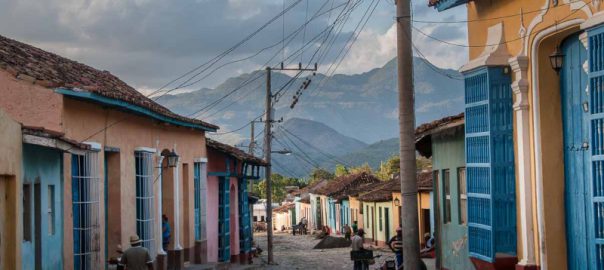
Trinidad selbst gehört zum Weltkulturerbe der UNESCO und wird als eine der schönsten Städte Kubas beschrieben. The cobblestones of the old town streets are famous and infamous, which is not particularly inviting for a stroll and is also difficult to keep clean. Our casa was again right in the center of the city in a good location 300 year old house, that is only eight meters wide, but it felt like twenty meters deep. Over the years, each generation had grown a little more. The backyard was very pleasant, from which our rooms opened. So you could easily enjoy some fresh running. After the long day, we just took a short walk through the city and were treated to dinner in our casa. Many of the private accommodations in Cuba also offer dinner, which is usually good and cheap. That was the case here too. After a delicious bean soup, we had grilled lobsters with salad, Rice and banana chips in huge quantities. You really couldn't complain.
The next day we wanted to go hiking in the nearby mountains. Topos de Colantes was recommended as a starting point. The way there wasn't far, but through the narrow ones, We had been on the winding roads for quite a while. Our path took us further and further up into the mountains and the barren landscape became increasingly covered in pine trees- and eucalyptus forests. Unfortunately, when we arrived at the information center, we didn't get what we had hoped for, a hiking map or guide. Far. After some back and forth it was clear, that no knowledgeable guide could be found for today. We were told that the hiking trails were not signposted either. The probability, that we would find our way back to our car this evening, could generally be classified as low and it was clearly discouraged, to go off alone. A little disappointed, we thought about it, to leave without having accomplished anything. But then another opportunity presented itself: From the nearby Casa de Cafe a signposted path led to a cave by a river. So we set off. The path led through the forest. In my opinion, unfortunately with far too many steep uphill and downhill sections. But that's just how it is in the mountains. Given the prevailing temperatures and my incredibly poor physical condition, I was already panting heavily. Nevertheless, the excursion into Cuba's nature was a blessing. We were alone for almost the entire route and were able to discover and observe many different new bird species, who are at home in this area. At the destination it became refreshingly cold. To get into the caves you had to wade through the stream, the water temperature felt like ten degrees. So our strained feet got a well-deserved cool down and then we headed back to the starting point with motivation. Sweaty and tired, we were happy, to be able to sit in the car again.
On the way home we were stopped by a Cuban road construction site. Schon am Morgen hatten wir eine Baustelle passiert, wo der alte Straßenbelag durch neue Betonplatten ersetzt wurde. Jetzt war aber gerade vor uns ein Betonmischer mit neuem Material angekommen. In mühsamer Handarbeit wurde der Beton erst in die Zwischenräume der schon gegossenen Platten gegossen und dann mit Schaufeln verteilt. Danach wurde die Oberfläche mit einem Brett grob abgezogen. Die Feinarbeit wurde abschließend mit der Maurerkelle erledigt. Das dauerte natürlich eine ganze Weile 🙁 Die armen Arbeiter, die in der Gluthitze diese schwere Arbeit machen mussten 🙁
Durch die Verzögerung kamen wir gerade noch so rechtzeitig in Trinidad an, that we were able to jump into the shower before meeting the Wolff family. Unfortunately, Trinidad was the last stop together and so we wanted to take the opportunity to have one last dinner together. This time the two had once again reserved a table in a charming restaurant, which was particularly noticeable due to its unusual interior design. tables, Chairs, Dishes and everything else were a collection of antiques from long ago, lovingly put together and staged. From the roof of the building you had an impressive view of the city and the beautiful sunset. We ended the evening with a mojito on the stairs in front of the Casa de Musica. Schade, dass das der letzte gemeinsame Abend gewesen war 🙁